01 Follow the material
Map the route from the receiving or staging point through transfers and conveying to the ship-side discharge.
——————————————————————————–
Efficient ship loading solutions for bulk materials and bagged cargo. Explore mobile ship loaders and integrated conveyor systems designed to support material transfer from receiving points to vessels at ports, harbours, and industrial terminals.
Every arrangement is subject to project requirements and engineering review.
A useful first conversation is specific to your operation. What material is moving? Where does it arrive? How does cargo meet the vessel? Those answers help identify a sensible system scope.
Map the route from the receiving or staging point through transfers and conveying to the ship-side discharge.
——————————————————————————–
Consider vessel access, loading positions, operating envelope, ground conditions and movement constraints.
——————————————————————————–
Separate what your project needs from options that may suit particular layouts or operating practices.
A system shaped around the cargo route.
Explore the product and system options, then share your context. Final equipment and configuration are project-specific.
01 / SYSTEMS
A mobile configuration can be considered where berth use or loading positions call for repositioning; travel and setup depend on the site.
Enquire about this solution ->
02 / SYSTEMS
A connected transfer route from a receiving or supply point toward the ship-side discharge, configured for the operation.
Enquire about this solution ->
03 / SYSTEMS
Bulk cargo handling shaped by material flow, transfer requirements, vessel access and berth conditions.
Enquire about this solution ->
04 / SYSTEMS
Conveying arrangements for bagged cargo, considered around staging, handling practice and the vessel interface.
Enquire about this solution ->
05 / SYSTEMS
A telescopic spout or suitable discharge arrangement may be considered where it fits cargo, control and vessel requirements.
Enquire about this solution ->
06 / SYSTEMS
A project-defined combination of receiving, transfer, conveying and ship-loading interfaces; not every stage is required in every system.
Enquire about this solution ->
Cargo characteristics shape the system.
Typical application conversations include the cargo groups below. Suitability, dust control, throughput and discharge arrangement depend on material properties and project specifications.
Bulk transfer and ship-side discharge are assessed around coal characteristics and the site’s dust-management requirements.
Material size, flow, wear considerations and the supply route inform the handling discussion.
Product form and handling conditions help determine a suitable conveying and discharge arrangement.
Grain transfer requirements are considered alongside source, route, vessel and relevant dust-control needs.
Mineral properties and the project operating target guide transfer and conveying choices.
Other materials can be discussed once their properties and operating conditions are understood.
Bagged cargo arrangements depend on package format, staging, handling practice and ship-side placement.
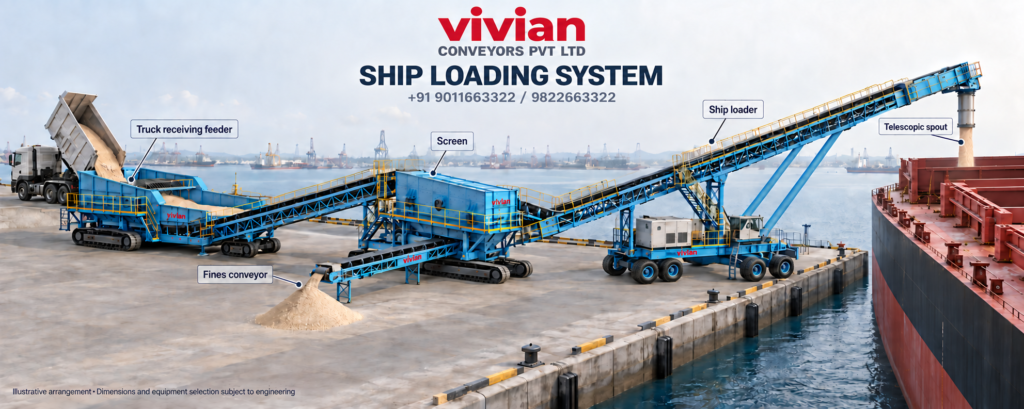
From receiving point to vessel.
Actual layouts are customised to the application, and not every system requires every component shown.
Truck Receiving Feeder
Receives material from trucks where this method suits the operation.
Material Screening, Where Required
Screening is considered only when required by material and process.
Transfer Conveyor
Transfers material along the project-defined route.
Fines Conveyor or Additional Transfer Conveyor, Where Required
An optional stage, determined by the material flow and layout.
Ship Loading Conveyor
Carries material toward the ship-side loading position.
Telescopic Spout or Suitable Discharge Arrangement
Selected to suit the material and vessel interface.
Cargo Discharge into the Vessel
The final discharge arrangement is project-specific.
Have a berth or cargo flow to discuss?
Share what you know about the material, supply point and vessel. We will take it from there.